Established in 1895 by Alfred Nobel's will, the Nobel Prizes have been honoring individuals who provide the greatest benefit to humanity for over a century. These awards not only celebrate scientific discovery but also the curiosity, perseverance, and desire to make the world a better place behind it. As with every year, in 2025, the awards given in various categories will reveal how science can offer powerful solutions to the great challenges we face. In this article, you will find the 2025 Nobel Prize winners in Physics, Chemistry, and Medicine, their fields of study, and how these discoveries touch our lives.
Nobel Physics Prize: Unlocking the Doors to the Quantum World
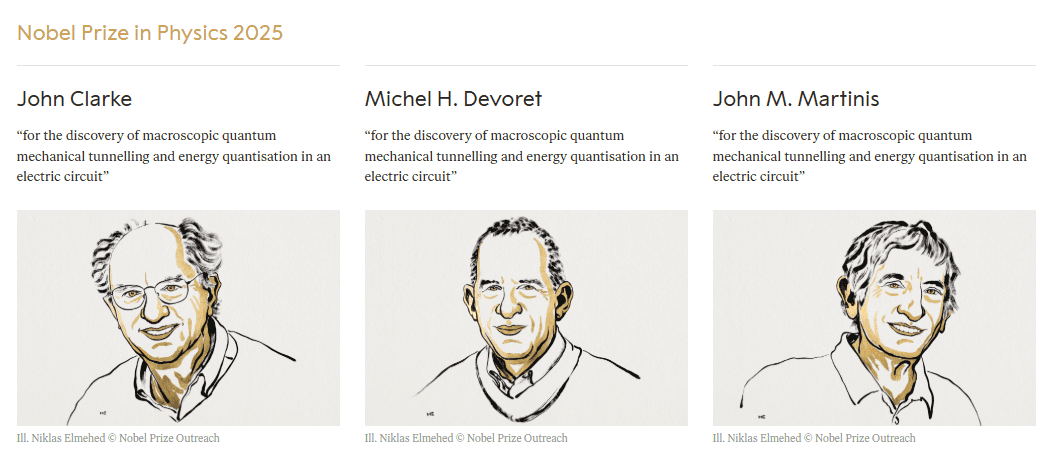
Prize Winners: John Clarke, Michel H. Devoret, and John M. Martinis
"For the discovery of macroscopic quantum mechanical tunneling and energy quantization in an electrical circuit."
The rules of quantum mechanics (such as a particle being in multiple places at once) are often extremely fragile phenomena that can usually only be observed at atomic and subatomic levels. Controlling and observing these rules in human-made, visible (macroscopic) systems was the biggest obstacle to creating revolutionary technologies like quantum computers. How could we stably reveal these quantum behaviors in a real-world electrical circuit?
Clarke, Devoret, and Martinis overcame this obstacle with their pioneering work. They designed tiny electrical circuits made of superconducting materials. These circuits could behave like artificial atoms, exhibiting quantum properties. Their most significant breakthrough was using a component called the "Josephson junction" to definitively show that the energy levels in these circuits were discrete like an atom, and electron pairs could quantum tunnel through a barrier.
This meant that quantum behavior at the atomic level could first be controlled and measured clearly in a human-made circuit composed of billions of atoms. Martinis' later works laid the foundation for scalable quantum processors by transforming these circuits into quantum bits known as "qubits." Thus, the principles of quantum mechanics have become experimentally testable in visible systems.
How will quantum computers developed in light of this work touch our lives?
Revolution in Medicine and Drug Development: Today, developing a new drug or vaccine requires long trial-and-error processes in the laboratory and costs billions of dollars. Quantum computers promise the ability to simulate complex molecules, like proteins targeted by drugs, at the atomic level. Thus, we can imagine a world where we understand the mechanisms of diseases like Alzheimer’s, Parkinson’s better and design more effective drugs for these diseases within months.
Tackling Climate Change and New Materials: Imagine more efficient solar panels, new-generation cables that transmit energy without loss, or catalysts that efficiently capture carbon dioxide in the atmosphere and convert it into useful chemicals. Quantum computers promise to make the design of such new materials with desired properties possible. Thus, while increasing energy efficiency, they also have the potential to offer brand new tools in the fight against climate change.
Smarter Finance and Logistics Systems: Predicting risks in financial markets or finding the most efficient route in a delivery network with thousands of vehicles are extremely difficult optimization problems even for classical computers. Quantum computers have the potential to find the best solution in this vast sea of possibilities much faster, creating more stable financial systems, faster and cheaper logistics operations, and more efficient production lines.
The Future of Data Security: The processing power of quantum computers poses a threat that can easily break many of the encryption methods we use today (such as those used in internet banking). However, the same quantum mechanics principles also form the basis for new-generation "quantum encryption" methods that are impossible to break. Thus, the race for how to protect our data in the future has begun.
Nobel Chemistry Prize: Building Smart Materials
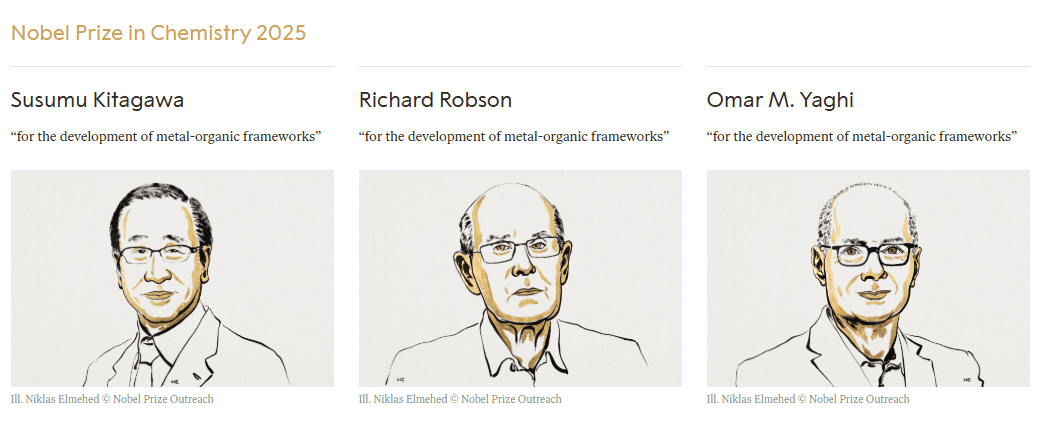
Prize Winners: Susumu Kitagawa, Richard Robson, and Omar M. Yaghi
"For the development of metal-organic frameworks (MOFs)."
Efficient materials have always been needed in the industry for storing, separating gases and speeding chemical reactions. Traditional porous materials (like activated carbon or zeolites) generally have limited capacity, low selectivity, and controlling the design precisely is quite difficult.
Kitagawa, Robson, and Yaghi brought a revolutionary solution to this problem known as "Metal-Organic Frameworks" (MOFs). MOFs are crystal-structured and extraordinarily porous materials created by combining metal ions and organic molecules. This structure is akin to "molecular Lego"; the components can be altered to precisely adjust the pore size, shape, and chemical properties for the intended purpose. This creates a high level of internal surface area. This feature allows MOFs to reach record levels of gas storage capacity.
How can these smart materials, defined as "molecular Lego," affect our everyday life?
Catching Water from Air Even in Deserts: While a significant portion of the world's population struggles with access to clean water, MOF-based devices promise to solve this problem by capturing water vapor in the air and converting it into drinking water. This technology could change the lives of millions by enabling us to obtain drinkable water from water vapor in the air even in the driest regions.
Tackling Climate Change: One of the most exciting promises of MOFs is their ability to capture carbon dioxide (CO₂) in the atmosphere. These materials can be designed to absorb CO₂ molecules like a sponge from a factory's chimney or directly from the air. This captured CO₂ can then either be stored underground or converted into useful chemicals and fuels. Hence, MOFs seem to be a powerful ally in our fight against one of the primary causes of climate change.
Cleaner Energy, Longer-Range Vehicles: Hydrogen and natural gas (methane) are cleaner alternative energy sources that could replace petroleum. However, safely and efficiently storing these gases is difficult and requires high-pressure, heavy tanks. MOFs stand out as the most promising materials capable of storing these gases at high capacity. This means the tanks of natural gas or hydrogen-powered vehicles can shrink, their range can increase, and they become safer.
More Effective Treatments and Fresh Foods: The internal structure of MOFs, composed of up to 90% voids, is also targeted for carrying drug molecules. This method can provide slow, targeted, and controlled release of a drug in the body, making treatments more effective. Similarly, MOFs that absorb ethylene gas, which causes fruits and vegetables to spoil, have the potential to extend the shelf life of foods and reduce food waste.
Nobel Medicine Prize: Understanding the Art of Body's Defense
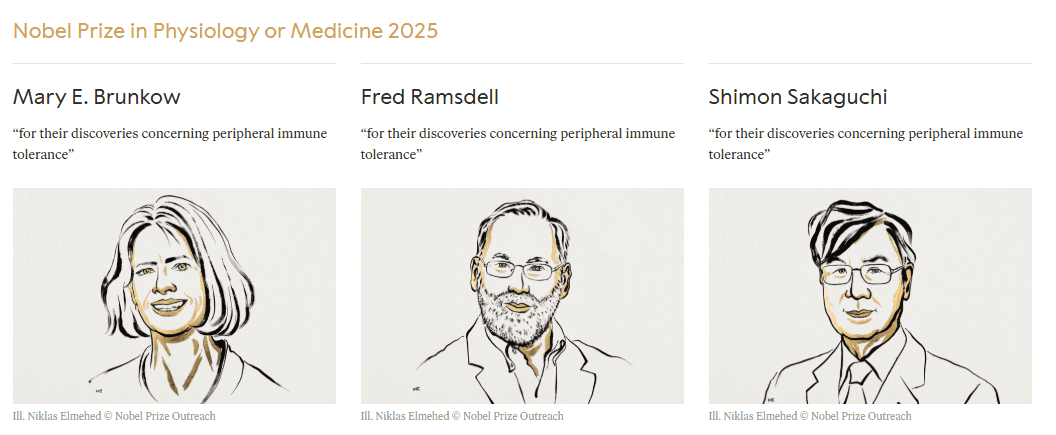
Prize Winners: Mary E. Brunkow, Fred Ramsdell, and Shimon Sakaguchi
"For their discoveries related to peripheral immune tolerance."
The immune system is a complex defense mechanism that protects the body against external threats such as bacteria and viruses. One of the most critical tasks of this system is to be programmed not to attack the body's own healthy tissues. When this self-tolerance mechanism is disrupted, the immune system perceives its own cells as enemies, leading to autoimmune diseases such as rheumatoid arthritis, type 1 diabetes, lupus, etc.
Shimon Sakaguchi’s works identified special T cells known as T regulatory cells (Tregs), carrying a marker called CD25 on their surfaces. He showed that these cells actively suppress immune responses and prevent autoimmunity. Simultaneously, teams led by Mary E. Brunkow and Fred Ramsdell discovered that mutations in the FOXP3 gene cause severe autoimmune diseases in both humans and mice. Shortly after, it was realized that FOXP3 is the master control gene for the development and function of Treg cells. These discoveries illuminated the molecular and cellular basis of peripheral immune tolerance (the learning of tolerance by immune cells in the rest of the body).
So, how can treatments developed with the illumination of peripheral immune tolerance change the lives of us or our loved ones?
Reprogramming Against Autoimmune Diseases: Millions of people struggle with diseases where the body attacks its own cells, like rheumatoid arthritis, multiple sclerosis (MS), type 1 diabetes, or Crohn's disease. Traditional treatments often work by suppressing the entire immune system, which can make patients vulnerable to infections. Conversely, Treg cell therapies being developed aim to reprogram the immune system, targeting the disease while preserving the body's remaining defense capabilities.
Fighting Cancer: Cancer cells are adept at hiding from our immune system to survive. One of the clever ways they do this is by attracting Treg cells around the tumor. These cells give a "stop" signal to the "warrior" T cells supposed to eliminate cancer, creating a shield for the cancer. Today, drugs aiming to deactivate this Treg shield around the tumor are being developed. Thus, the body's own "warrior" cells can recognize cancer as a threat and attack with full force.
Enabling "Acceptance" in Organ Transplants and Allergies: When an organ transplant is performed, the biggest risk is that the body perceives the new organ as foreign and rejects it. Many patients may have to use heavy immunosuppressive drugs for a lifetime to prevent this situation. New therapies based on Treg cells aim to teach the immune system to accept the transplanted kidney or liver as a "friend." This development opens the door for transplant patients to lead healthier lives without constant drug dependency. Similarly, efforts are underway to soothe severe allergic reactions like peanut allergy, asthma, or hay fever and prevent the immune system from overreacting to these harmless substances.
The 2025 Nobel Prizes demonstrate how science shapes our lives by emerging from laboratories. Quantum circuits make computers possible, smart materials enable a sustainable world, and immune system discoveries enable healthier living. Those redefining tomorrow's world emerge as heroes Alfred Nobel described as "those who provide the greatest benefit to humanity."
Sources
Physics
What Is Quantum Computing? | IBM https://www.ibm.com/think/topics/quantum-computing
The Path to Building Quantum Advantage | BCG https://www.bcg.com/publications/2021/building-quantum-advantage
Chemistry
Can Tiny Compounds Make Our Planet Greener? | MERCK https://www.merckgroup.com/en/research/science-space/envisioning-tomorrow/scarcity-of-resources/mof.html
Medicine
Opportunities for Treg cell therapy for the treatment of human disease | Nature https://pmc.ncbi.nlm.nih.gov/articles/PMC10154599/