Researchers have developed a non-invasive wearable biosensor to track reproductive hormones in sweat in real time, marking a significant advance in women's health technology.
🔍 Game Changer: Imagine a world where we can track key health indicators as simply as wearing a ring. With the development of this wearable biosensor, the future is now closer than ever. This biosensor can directly monitor the reproductive hormone estradiol from sweat. This advancement could radically alter our approach to women's health and reproduction.
🌐 Behind the Scenes: At the heart of this sensor is a combination of nano-engineering and molecular biology. By using state-of-the-art microfluidics, the device captures sweat and analyzes it with specially designed aptamers, which are DNA/RNA strands tailored to selectively bind to estradiol molecules. This innovative approach provides a glimpse into the future of tracking personal health parameters by eliminating the need for traditional, more invasive blood tests.
What is an Aptamer: Aptamers are short, single-stranded DNA or RNA sequences that bind to a specific target molecule.
👩🔬 Why It Matters: Women have long relied on invasive methods for reproductive tracking. This sensor not only simplifies the process but also does so with remarkable accuracy. It provides women with real-time, detailed insights into their reproductive health, offering significant empowerment benefits.
📱 Real-Time and Precise Data: Tests have shown that this biosensor provides accuracy levels comparable to traditional blood tests. In addition to monitoring estradiol, it also tracks skin temperature and sweat composition, providing precise hormone level readings. This data integrates seamlessly into our daily digital routines, syncing effortlessly with smartphones.
🔬 The Future: The research team envisions a future where multiple hormones can be tracked simultaneously. This sensor offers a significant step towards a holistic, non-invasive tracking system that fits neatly into our vision of personalized medicine.
🔗 Explore the Study in Depth: https://www.nature.com/articles/s41565-023-01513-0

Schematic and layer-by-layer design of the flexible and wireless microfluidic wearable patch providing automated sweat induction through iontophoresis for estradiol analysis. Photos of the sensor patch for hormone tracking and the fully integrated wireless wearable patch worn on the finger. Sections from I to VII: FPCB (I), inkjet-printed sensor array (II), carbamoly-loaded hydrogels (carbagels) (III), microfluidic channels (IV), biological recognition interface (V), representing the plastic substrate interfacing with the sweat accumulation layer (VI) and skin (VII). Scale bars are 1 cm long.
Ultra-compact sensors with high resolution are among the most critical developments paving the way for developing wearable technologies. Quantum sensors lead these technological advancements. One of the best examples of these developments is the unique technology developed by NIQS Tech, a Hello Tomorrow Deep Tech Pioneer. The optical sensor and innovative sensor material developed by researchers at the University of Leeds in the UK, measuring blood glucose levels, offers a beacon of hope for individuals with diabetes.
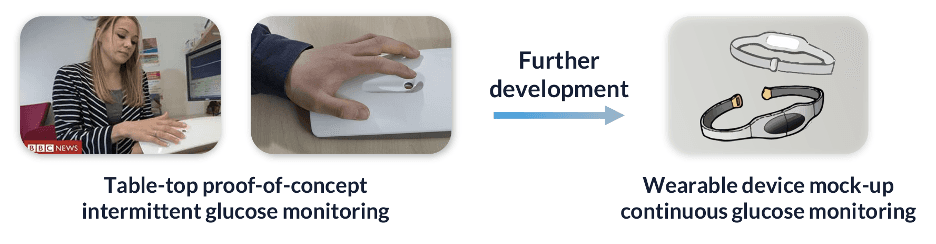
NIQS Tech's technology has been clinically tested on desktop experiment setups, achieving an accuracy of around 80%. They continue their efforts to enhance this accuracy and transform the technology into a wearable product with new developments.
Let's also examine the developments at CERN, the center where quantum technologies are developed and the heart of science beats in Europe.
CERN's Quantum Technology Initiative (QTI) is ushering in a new era of collaboration between quantum technology and high-energy physics. The recently completed first phase of a bridge-building effort, leveraging the specialized skills of scientists and engineers at CERN, was crucial in identifying potential areas that could have a substantial impact on high-energy physics.

Globe of Science and Innovation, CERN, Switzerland
🪫Creating a quantum technology community within high-energy physics is one of the main achievements of CERN QTI. Scientific and technological progress, capacity building, and establishing collaborative development bridges between industry and academia were focal points of the strategic roadmap announced in 2021. The roadmap demonstrated that CERN has many responsibilities related to quantum theory, computing, sensing, and networking, among many other areas.
The initiative shows its commitment to promoting information exchange and technological dissemination by hosting prestigious conferences such as the International Conference on Quantum Technologies for High-Energy Physics and Quantum Techniques in Machine Learning.
🇨🇭CERN's Technology Transfer department is making significant progress in integrating CERN QTI into business plans. The goal of this department is to examine unmet demands in the quantum supply chain to ensure that the industry makes the most of CERN's quantum technology knowledge. By being a member of groups such as the European Quantum Industry Consortium, CERN has underlined that it will actively play a role in the creation of quantum technologies.
CERN QTI is a fine example of how effective teamwork and new ideas can be when high-energy physics and quantum technology converge. Its current and future successes and goals show its importance as a driving force behind scientific progress, linking many fields and impacting the development of quantum technologies in high-energy physics and beyond.
CERN also supports both its employees and industry experts in commercializing these technologies. By providing extensive support to entrepreneurs aiming to establish businesses based on CERN technology and expertise, actively encouraging the formation of spin-off companies. Highlighting the importance of intellectual property and assisting with licensing technologies for new ventures, CERN has established Business Incubation Centers in member states to support entrepreneurs with ideas related to CERN's fields, providing a comprehensive ecosystem for technology transfer and entrepreneurship development.
Attend the Hello Tomorrow türkiye Summit on February 22 at DasDas stage to listen to Ash Ravikumar, CERN's Head of Entrepreneurship Development, give the keynote speech titled “Accelerating Breakthrough Innovations with Deep Tech Entrepreneurship and Maximizing CERN's Positive Impact on Society”! https://hello-tomorrow.org.tr/hello-tomorrow-turkiye-summit
Additional Resources:
“End-to-end Design of Wearable Sensors” paper by Prof. Can Dinçer: https://www.nature.com/articles/s41578-022-00460-x
CERN technologies in the world of health: